Fraud Detection Analytics: Tools, Techniques & Best Practices 2026
Last Updated: March 3, 2026
Key Takeaways
- Organizations using proactive fraud analytics reduce losses by 50% compared to manual detection methods
- Real-time anomaly detection and machine learning identify fraud in milliseconds, not days
- Supply chain fraud costs businesses $350M annually; AI-powered detection is now essential
- Hybrid human-AI approaches outperform standalone systems by combining speed with expert judgment
- Adaptive analytics that learn from confirmed cases stay ahead of evolving fraud tactics
What Is Fraud Detection Analytics and Why It Matters Now
Fraud detection analytics uses statistical methods and machine learning to identify fraudulent transactions and activities in real time, catching threats before they drain your budget. It's fundamentally different from the manual reviews and static rule sets most organizations still rely on, which fraudsters routinely exploit.
The numbers tell a stark story. 79% of organizations faced payment fraud attempts in 2024, and a typical corporation loses 5% of its annual revenue to fraud. That's not a rounding error; that's a strategic hemorrhage.
Here's what separates winners from losers: organizations using proactive data analytics reduce fraud losses by roughly 50% compared to those relying on outdated defenses. Research from the Association of Certified Fraud Examiners confirms that analytics-driven approaches dramatically outperform traditional methods.
Why the gap exists is simple. Manual processes can't scale. Static rules become obsolete the moment fraudsters adapt. Your team reviews exceptions after damage is done, not before. Analytics flips this dynamic entirely, analyzing millions of transactions simultaneously, spotting patterns humans miss, and flagging anomalies in milliseconds.
The urgency is real. Fraud evolves faster than most organizations can respond. Whether you're managing payment processing, expense reports, or supply chain transactions, you're competing against sophisticated schemes designed to evade yesterday's defenses.

Core Fraud Detection Techniques and How They Work
Most organizations rely on reactive fraud detection, catching criminals after damage is done. Modern analytics flips this by predicting fraud before it happens. Here's how the core techniques actually work.
Anomaly detection identifies transactions or behaviors that deviate from established baselines. A customer who typically spends $200 monthly suddenly purchasing $5,000 in electronics triggers a flag. According to DataCamp's fraud analytics guide, anomaly detection helps identify unusual behaviors pointing to potentially fraudulent activity. In supply chain fraud, this might catch a vendor suddenly requesting payment to an unfamiliar bank account.
Pattern recognition goes deeper, uncovering complex relationships in transaction data. Feedzai research shows that pattern recognition AI algorithms can recognize complex patterns and relationships to detect fraudulent activities. A fraudster might use multiple payment methods, different shipping addresses, and specific product combinations that create a detectable signature.
Behavioral analytics tracks how customers normally interact with accounts. When someone logs in from a new geography, changes passwords, and immediately initiates transfers, behavioral systems flag account takeover attempts before funds move. Financial services firms use this to prevent credential compromise fraud.
Statistical outlier detection applies mathematical rigor to spotting suspicious transactions. Methods like z-scores and isolation forests identify data points significantly different from the rest of the distribution. A payment processor might flag a transaction 4 standard deviations above normal spending as high-risk.
Link analysis reveals networks of fraud. Rather than viewing transactions in isolation, this technique maps relationships between accounts, devices, email addresses, and IP addresses to uncover organized fraud rings operating across multiple identities.
The real power emerges when organizations combine these techniques into layered detection systems.
Machine Learning vs. Traditional Rule-Based Systems
Your organization's fraud detection system likely relies on rule-based logic: if transaction amount exceeds $X, flag it; if customer location changes suddenly, block it. These rules work beautifully, right up until fraudsters learn them. And they always do.
Rule-based systems are fundamentally static. Once a criminal understands your detection triggers, they adapt their tactics accordingly. Your rules become obsolete almost as soon as you deploy them. As research shows, "rules can do an excellent job of uncovering known patterns but rules alone aren't very effective at uncovering unknown schemes or adapting to new fraud patterns" (SAS fraud detection research).
Machine learning flips this dynamic entirely. Rather than relying on predetermined conditions, ML models continuously learn from confirmed fraud cases in your system. They identify patterns humans never explicitly programmed, adapting in real time as fraud tactics shift. FICO's research demonstrates that "machine learning models perform thousands of computations in milliseconds to continuously adapt to new incoming data and clearly distinguish fraudulent and genuine transaction patterns in real time."
Two approaches dominate the ML landscape. Supervised learning requires labeled historical data, making it precise but dependent on knowing what fraud looks like. Unsupervised learning detects novel fraud types without prior examples, catching entirely new schemes before they become widespread.
The most powerful approach combines both with adaptive analytics. These systems automatically adjust detection weights based on recent confirmed cases, staying ahead of evolving fraud tactics without manual rule updates. Your detection system doesn't just catch today's fraud; it anticipates tomorrow's.

Enterprise Fraud Detection Tools and Platforms
Enterprise fraud detection platforms have evolved dramatically, moving far beyond simple rule-based systems. Today's solutions combine machine learning, real-time processing, and consortium intelligence to catch sophisticated fraud before it costs your organization millions.
FICO Falcon synthesizes intelligence from billions of payment-card transactions, applying proprietary neural-network analytics to spot fraud in microseconds. This means potential threats are identified and blocked in the time it takes to process a single transaction. For financial institutions handling massive transaction volumes, this speed advantage is critical.
SAS Fraud Management uses in-memory processing to score every transaction instantly, even in high-volume environments, so suspicious activity can be flagged before losses occur. The platform excels at adapting to evolving fraud patterns without requiring constant manual rule updates, making it ideal for organizations tired of playing catch-up with emerging threats.
Verafin fraud detection software provides fraud prevention through a consortium-based analytics model that uses anonymized data from thousands of financial institutions. This collaborative approach gives you visibility into fraud patterns across your entire industry, not just within your own transaction history.
Beyond these flagship solutions, specialized platforms address specific fraud vectors. Supply chain fraud requires different detection logic than payment fraud or account takeover attempts. Retail organizations need tools that distinguish between legitimate bulk purchases and organized retail crime. Financial services benefit from platforms that integrate seamlessly with existing ERP systems and security infrastructure.
The key is matching your platform to your specific risk profile. A mid-market retailer faces different fraud threats than a global payments processor. Enterprise deployments should prioritize solutions offering flexible integration, transparent model logic, and proven performance in your industry vertical.
Real-Time Detection and Adaptive Analytics in Action
Speed is where fraud detection separates theory from reality. Real-time monitoring immediately flags anomalies before transactions settle, cutting potential losses dramatically compared to batch processing that runs hours or days later. A major financial institution processing millions of daily transactions can't afford to wait; every second counts when unauthorized activity is happening.
Here's how it works operationally. Machine learning models continuously analyze subtle behavioral signals: typing rhythms, mouse movement patterns, spending habits, transaction locations, and login times. When a customer's behavior deviates from their baseline, the system triggers an alert. A customer who normally shops locally suddenly making international purchases at 3 AM? The system catches it immediately.

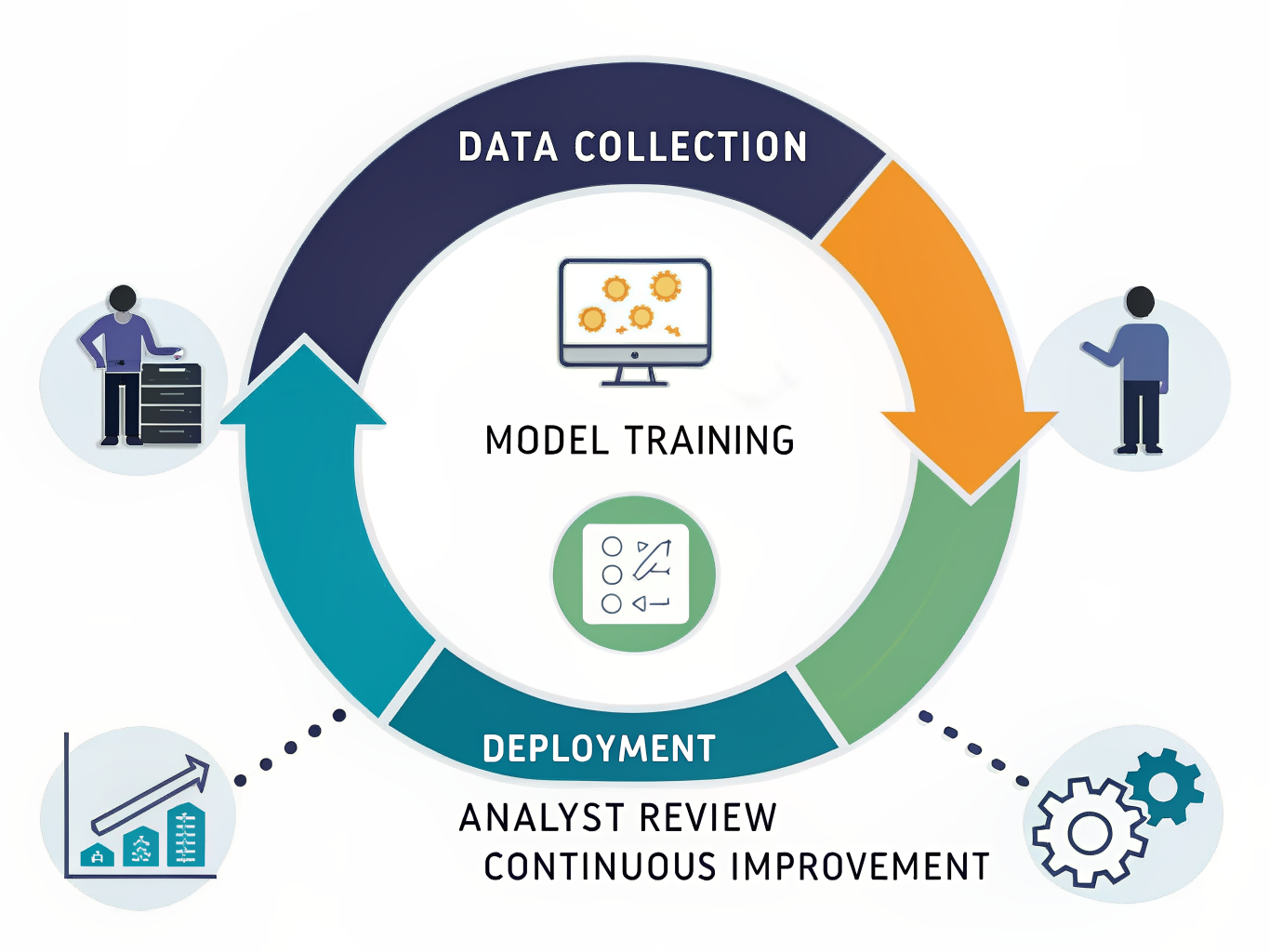
The challenge isn't speed alone; it's accuracy. Too many false positives paralyze your team and frustrate legitimate customers. Adaptive systems solve this through continuous learning. When an analyst investigates a flagged transaction and confirms it as legitimate or fraudulent, that outcome feeds directly back into the model. The system learns from real-world outcomes, improving its precision over time.
Supply chain operations benefit equally. A procurement system might flag a vendor suddenly requesting wire transfers to a new account, or unusual order quantities that deviate from historical patterns. The adaptive engine learns what's normal for each vendor, reducing noise while catching genuine threats.
This human-in-the-loop approach matters critically. Automation handles high-volume screening efficiently; analysts focus exclusively on edge cases requiring judgment. Your team investigates suspicious activity that actually warrants investigation, not sorting through thousands of false alarms. Continuous model retraining keeps detection ahead of evolving fraud tactics, ensuring your defenses strengthen as threats evolve.
Fraud Detection Analytics for Supply Chain and Procurement
Your supply chain and procurement operations are hemorrhaging money through fraud, and most organizations don't realize it until it's too late. "Nearly $350 million are lost worldwide to supply-chain fraud in manufacturing companies" annually, yet detection remains fragmented across disconnected systems manufacturing fraud statistics.
The fraud types hitting your bottom line are predictable: duplicate invoices, overbilling schemes, vendor collusion, and inventory theft. What makes them dangerous is their invisibility within traditional audit cycles. By the time quarterly reviews surface anomalies, the damage compounds.
Modern analytics change this equation. AI-powered detection integrated directly into your ERP systems monitors procurement workflows in real time, catching red flags before payments process. "By using AI to automate fraud detection, a manufacturer can instantly pick up on red flags as excessive shrinkage in inventory, an abnormal rise in invoice volumes, split purchase orders, and multiple payments to vendors without corresponding services" procurement fraud detection techniques.
The cost of inaction is staggering. "Occupational fraud costs almost $200,000 per incident" ACFE occupational fraud research, but supply chain schemes often involve multiple touch points, multiplying exposure.
Smart resource allocation through analytics lets you prioritize investigation efforts on highest-risk transactions rather than chasing every anomaly. You'll identify suspicious vendor patterns, flag invoice inconsistencies, and detect collusion networks that manual review misses entirely.
The gap between organizations with advanced detection and those relying on spreadsheets and gut instinct is widening. Your competitors are already monitoring. The question is whether you'll lead or lag.
Best Practices for Implementing Fraud Detection Analytics
Successful fraud detection analytics deployment requires a structured, iterative approach. Here's your roadmap:
Start with clean data. You need balanced training datasets containing both legitimate and fraudulent transactions. Poor data quality cripples even sophisticated models. Invest time upfront labeling examples accurately; this foundation determines everything downstream.
Integrate deeply with existing systems. Connect your fraud detection platform directly to ERP, payment processing, and transaction systems for real-time flagging. Delayed alerts are useless alerts. More data equals better machine learning models for fraud detection, with practitioners needing platforms that scale as data and complexity increase.
Build feedback loops into your workflow. When analysts review flagged cases, their decisions become training data. This continuous labeling cycle keeps your models sharp as fraud tactics evolve. Without it, model performance degrades within months.
Monitor relentlessly. Ongoing monitoring of machine learning fraud detection systems is imperative for success as populations and underlying data shift. Set up dashboards tracking accuracy, false positive rates, and detection lag. Retrain models quarterly at minimum, more frequently if fraud patterns shift.
Embrace human-AI collaboration. Let automation handle high-volume screening; deploy your best analysts on complex, ambiguous cases requiring judgment. Organizations achieve the most significant performance improvements when humans and AI tools work together through collaborative intelligence. This hybrid model catches sophisticated fraud that pure automation misses.
FAQ: Fraud Detection Analytics Questions Answered
What ROI should we expect? Organizations using proactive data analytics experience fraud losses 50% lower than those relying on manual detection. Beyond loss prevention, you'll see operational efficiency gains from automating investigation workflows and reducing false alarms that drain your team's bandwidth.
How long until we're operational? Full deployment typically takes 3-6 months, depending on your data maturity. If your systems are fragmented or poorly documented, expect closer to six months. Organizations with clean data infrastructure move faster. Don't rush this phase; a solid foundation prevents costly rework later.
Can we really cut false positives? Yes, but it requires continuous effort. The solution isn't setting one threshold and forgetting it. Use diverse training data reflecting your actual transaction patterns, implement adaptive thresholds that adjust as fraud evolves, and establish feedback loops where investigators validate alerts. Most teams reduce false positives by 40-60% within the first year.
Will this integrate with what we already have? Modern platforms integrate with ERP systems, payment gateways, and security infrastructure through APIs and standard connectors. Legacy systems sometimes require middleware, but integration challenges are rarely a dealbreaker. Ask vendors for a technical assessment during evaluation.
How do we pick the right vendor? Evaluate on accuracy rates for your specific fraud types, detection speed (milliseconds matter), integration capability with your tech stack, and quality of ongoing support. Request a proof-of-concept using your actual data. The cheapest option rarely delivers the best results.
The Future of Fraud Detection: Emerging Technologies and Trends
The fraud detection landscape is shifting rapidly, and organizations that don't evolve their analytics capabilities will fall further behind.
Deep learning and neural networks are becoming essential because they detect non-linear fraud patterns that traditional rule-based systems simply miss. These models learn from massive datasets, identifying subtle correlations between variables that signal fraudulent behavior before it causes damage.
Graph neural networks are capable of processing billions of records to identify patterns across wide swaths of data to track and catch even the most complex frauds. This matters because modern fraud rarely happens in isolation; it's embedded in networks of relationships, transactions, and entities. GNNs excel at mapping these connections, exposing fraud rings that would remain invisible to traditional analytics.
But power without transparency creates problems. Explainable AI (XAI) is no longer optional. Your fraud analysts need to understand why a transaction was flagged, not just that it was. This builds trust in your systems and enables faster, more confident decision-making.
Blockchain integration is reshaping supply chain fraud prevention by creating immutable audit trails. Every transaction leaves an unalterable record, making it exponentially harder for bad actors to manipulate records.
The threat landscape itself is evolving. Synthetic identity fraud and deepfakes represent emerging tactics that require continuous model evolution. Static models become obsolete within months. Your fraud detection strategy needs built-in agility; models must retrain regularly on fresh threat data.
Organizations that implement these technologies now gain competitive advantage through faster detection, lower false positives, and stronger regulatory compliance. Those that wait will continue losing millions to increasingly sophisticated fraud schemes.
Conclusion: Protect Your Enterprise with Proactive Fraud Detection Analytics

The math is brutal and simple: A typical corporation loses 5% of its annual revenue to fraud. For most enterprises, that's millions of dollars vanishing annually while legacy detection systems play catch-up with increasingly sophisticated schemes.
Your organization doesn't have to be another statistic.
The gap between reactive fraud management and proactive analytics isn't theoretical anymore. Organizations implementing machine learning-driven detection reduce fraud losses by 50% while simultaneously improving operational efficiency. That's not a nice-to-have; it's a competitive necessity. 79% of organizations faced payment fraud attempts in 2024, and static rules simply can't keep pace with evolving tactics.
The winning formula combines what machines do best (processing massive datasets at speed) with what humans do best (contextual judgment and strategic thinking). This hybrid approach catches fraud before it costs you, not after.
Here's what matters right now: evaluate your current detection capabilities honestly. Are you still relying on manual reviews and threshold-based alerts? That infrastructure worked five years ago. Today, it's a liability.
The organizations pulling ahead aren't waiting for perfect solutions. They're implementing analytics-driven fraud detection today, learning from real patterns, and continuously improving. The cost of inaction compounds daily.
Your move. Start the evaluation this week. Your revenue depends on it.
Keep reading

Critical Third Parties: UK Cloud Rule Explained
A Critical Third Party is a provider whose service failure could threaten UK financial stability. The first UK designations are four cloud providers.

Netflix Earnings Put Always-On TV in Focus
Netflix reports Q2 results July 16 after reports it is weighing always-on channels. Arkolith maps NFLX to $284.0B in tracked 13F value.

UK Cloud Watchlist Maps to $4.45T in 13F Value
The UK's first cloud oversight list maps to Microsoft, Alphabet, Amazon and Oracle, which Arkolith tracks across $4.45T of Q1 2026 13F value.